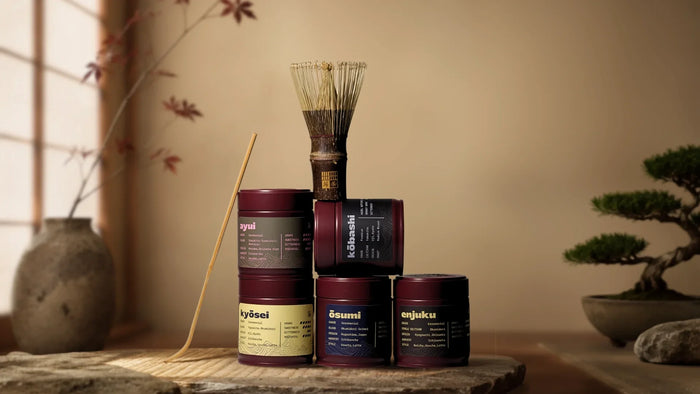
Where Ceremony Continues
2 min read
Share
Share
Sixteen Matcha is an independent ceremonial matcha house, built on the traditions and philosophy of the Japanese tea ceremony.
The House exists to preserve ceremony in the modern world — through authentic ceremonial matcha, thoughtful hospitality, and objects designed for everyday ritual.
We take our name and our entrance from the *nijiriguchi*, the humble doorway to the traditional tea room. It is deliberately small. Every guest, regardless of who they are outside, must bow to pass through it. Status remains at the threshold. Presence enters.
We do not imitate Japan. We continue, with reverence, what its tea masters have shaped for centuries.
A Practice, Not an Invention
Matcha's history began in China during the Tang Dynasty, where tea was steamed, ground into powder, and whisked with hot water. During the Song Dynasty, this became a refined practice of craftsmanship and discipline.
In 1191, the monk Eisai carried tea seeds — and the practice of powdered tea — to Japan. Over the centuries that followed, Japanese tea masters shaped it into *chanoyu*, the Way of Tea: a practice built on harmony, respect, purity, and tranquility.
Among them was Sen no Rikyū, who introduced the *nijiriguchi* itself — a doorway low enough that every guest, of any rank, had to bow to enter. A reminder that ceremony begins with humility, before the tea is ever prepared.
We do not claim this history. We honor it. Every offering from the House is a quiet continuation of a practice that began long before us, and will continue long after.
The Meaning of Sixteen
To the world, sixteen marks a threshold — the point where deliberate effort becomes reflex, where practice yields mastery. In Kendo, in Zen, in the martial disciplines, it evokes the sixteenth level, the stage where what was once taught is now simply *lived*.
Within the House, sixteen carries a second meaning, one we don't write down or translate into rule. It is passed on the way ceremony has always been passed on — observed, practiced, and carried forward.
The First Offering
The House begins with a single offering: ceremonial-grade Japanese matcha, presented in reusable archival tins. Each tin is a vessel, not a container — made to be kept, refilled, and returned to, again and again.
When you bring a tin of 16 Matcha into your home, you're not bringing back a souvenir. You're beginning a practice.
Where This Is Going
One day, the House will open a Matcha Bar — not a café, but a room where the same ceremony found in every tin is prepared and shared in person. Guests will be welcomed, not served. Tea will be prepared, not produced. Every visit an invitation to slow down.
No matter the form it takes — a tin, or eventually a room — the purpose stays the same.